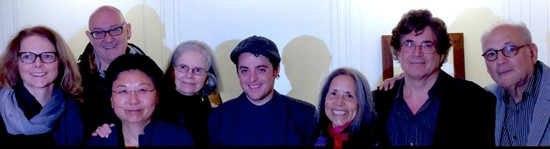
Hannah Weiner — Clairvoyant Journal
Performed by Regina Beck, Sharon Mattlin, Peggy De Coursey, and Hannah Weiner.
Originally issued as an audiocassette by New Wilderness Audiographics, 1978. Used by permission of Charles Morrow Associates Inc & Charles Bernstein for Hannah Weiner in trust.

March | April in MP3 format

March | April in Real Audio format (from Factory School Audio Archive)

"May from the Journal in June"
Performed by Rochelle Kraut, Sharon Mattlin, and Hannah Weiner.
Recorded by Charlie Morrow live at St. Mark's Poetry Project circa 1978. Unissued / excerpt issued with WAY / the audio edition (Kenning - a newsletter of contemporary poetry, poetics, & nonfiction writing vol. 4 no. 3, issue #12) - order from Small Press Distribution. Used by permission of Charles Morrow Associates Inc & Charles Bernstein for Hannah Weiner in trust.

May excerpt in MP3 format (from Kenning #12 - WAY / the audio edition)

May in MP3 format

Clairvoyant Journal
Performed by Charles Bernstein, James Sherry, and Hannah Weiner.
Recorded 1981, New York City, and previously unissued; from the archive of Charles Bernstein and published here by permission of Charles Bernstein for Hannah Weiner in trust.

Clairvoyant Journal 1981 in MP3 format

Clairvoyant Journal 1981 in Real Audio format

Clairvoyant Journal 1981 in streaming Real Audio format


[ about the Clairvoyant Journal ]

"A Short Interlude to Discuss Voices"
from Weiner, Hannah, and Andrew Schelling. "Mostly About the Sentence."
Jimmy & Lucy's House of "K" 7 (1986): 54-70.

I did, in the Magritte Poems, use a response to the verse, printed at the back of the poems, giving it a second "voice." In The Code Poems almost all (and I think all the ones published) were a statement and answer between 2 voices, people or ships. Two or three people read the poems aloud in performance. Sometimes I read both parts myself as in the movie "Any Chance of War" and in a non-performance reading situation. The idea of 2 "voices" is natural to The Code Poems as the code was developed for communication between vessels or between mariners lost at sea and a ship.

So the idea of using more than one "voice" or separate "voices" pre-dates the Clairvoyant Journal 1974. To clear up the matter of the three voices in this book, printed in regular type, CAPITALS or italics: at that time — Jan.-June 74 — I saw words in a wide variety of sizes, script and printed, on my own forehead (the large capital words on my forehead began in a retreat in June 1973 (Unpublished Journals, 1973)), and on other people, forehead included, and on every other imaginable surface or non-surface; the wall, the typewriter, the paper I was typing on, people's clothes, the air, and even words strung out in the air from the light pull (a favorite place), anywhere.

I bought a new electric typewriter in January 74 and said quite clearly, perhaps aloud, to the words (I talked to them as if they were separate from me, as indeed the part of my mind they came from is not known to me) I have this new typewriter and can only type lower case, capitals or underlines (somehow I forgot, ignored or couldn't cope with in the speed I was seeing things, a fourth voice, underlined capitals) so you will have to settle yourself into three different prints. Thereafter I typed the large printed words I saw in CAPITALS, the words that appeared on the typewriter or the paper I was typing on in underlines (italics) and wrote the part of the journal that was unseen, my own words, in regular upper and lower case.

It turned out that the regular upper and lower case words described what I was doing, the CAPITALS gave me orders, and the underlines or italics made comments. This is not 100% true, but mostly so.

The description of the voices is an integral part of the sentence discussion, as with three or even 2 operating there was scarcely chance to complete the phrase or sentence.

The situation of the voices, and the interruption and overlay, is quite clear if you hear the tape made by New Wilderness Audiographics wherein Sharon Mattlin is a wonderful CAPITALS and bosses me around endlessly. Peggy De Coursey read the italics for March and Regina Beck for April. Unprinted is a tape with Rochelle Kraut reading italics for May and myself alone reading the June Retreat. Peggy and Regina both sound as if they were scolding me. We worked it so that the voices came fast after each other, occasionally speaking in unison and overlapping, and occasionally one of us would ad-lib a comment.

I want to add it was an enormous amount of fun, through hard work requiring a lot of rehearsals to prepare for the tape. Performances were a little freer, requiring less perfection. These readers and others put up with endless work and no or little monetary reward. Sharon used to get a bowl of cereal but she sounded funny in rehearsal and Peggy got fare to Brooklyn.

Since then all my books are written for one voice, though dis-continued and interrupted, and I have the lonesome pleasure of reading them all by myself.

home