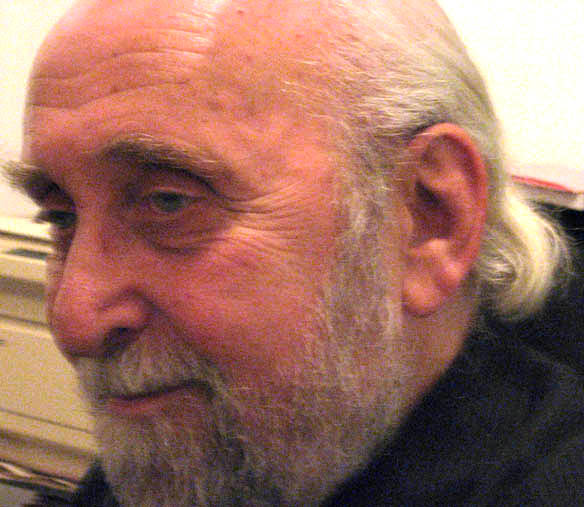
Mike Kelleher
________________________
Placeless Intro
How I Came to Inhabit
the City I Never Built
The idea for this gathering
came from three places: a conversation with Robert Creeley, an e-mail
correspondence with Scott Pound, and a thread on the poetics list.
When I showed him a poem
of mine called Atopia, Creeley asked two questions: what does "atopia"
mean? and what does placelessness have to do with your life? The word "atopia"
is derived from two greek words: 'topos", meaning "place," and "a," meaning
"lacking" or "without." Thus my translation of atopia as "placelessness."
I have since found out that the greek term "atopos" in common usage actually
meant (and still means) "out of place or unnatural." In other words, "weird."As
to its relevance to my life, well, suffice to say I find the question "Where
are you from?" vexing, to say the least.
I then found out that
Scott Pound had given a presentation a few years back entitled, "Atopian
Poetic: Forms of Community in Robin Blaser's Image-Nations." I asked him
to send it to me and thus began a correspondence between us concerning
atopia, placelessness and poetics. In the Blaser essay, Scott defines atopian
space as "the non-space of non-symmetrical reciprocity that exists
between language and the real where the two orders participate in one another
in the formation of poetry, community and cosmos." Elsewhere he calls it
a "poesis of found space."
I'll come back to this
in a moment.
The third source of the
idea came from a discussion thread on the poetics list regarding the experience
of receiving and reading web-based poetry journals. Having just begun to
publish one, I was curious to know how web-based poety was received by
the members of the poetics list. What I found was that it was still
a somewhat divisive and contentious issue for many who, despite the amount
of time they spend reading and posting opinions to an electronic discussion
forum, seemed uncertain about the status of web-published poetry
as opposed to print. One person claimed that poets should hate technology
and another said that the lack of phyical presence, of a body and a voice
behind the words, lessened the power of the word with a capital W. The
other side of the debate, which I encountered within various books I was
reading on the topic, had that faintly moldy whiff of utopianism in its
claims for a form of "pure" democracy they thought the web represented.
Which brings me back to
Scott.
How I Came to Build
the City I Never Inhabited
The literal translation
of "utopia" is "no place."
In other words, place
without presence.
What interests me most
about Scott's notion of atopian poeisis, that which resembles most my own
notions, is his careful effort to disentangle a atopian discourse from
the often impossible claims of utopian discourses. Of Blaser's "Image Nations"
poems, Scott writes that they are "atopian resistances to the idealized
strategies of utopian discourse, and responses to the challenge of writing
community in something of the form of its occurrence," a "series of events
with a certain duration, pitch and movement." Thus the placelessness
of the poem is the state in which idealized discourse is discarded in favor
of an active practice within what Barthes calls "a relation without a site."
In other words, presence
without place.
My sense of atopian space
stems from my experience on the web. The web serves, I believe, as the
model par excellence of atopian space. It is a placeless locus of
textual interaction whose principle feature, as opposed to, say, the physical
presence of a book, or the sensual sonics of the spoken word, is movement.
The experience of text on the web, though often professing to have modeled
itself on real space, as in virtual cities, chat rooms, internet cafes,
strip joints, doctorís offices or information desks, has as its principle
dynamic that of movement as opposed to stasis, properties more closely
related to time in the abstract than to physical space in the concrete.
What determines the experience
of the text in cyberspace, whatever its "real-world" model, is the speed
at which it is presented. Thus the experience of a chat room is characterized
by the attempt to keep up with a text scrolling down the screen before
the words of the interlocuter disappear into visual silence, whereas the
experience of reading postings off a listserv is slower, more apposite
of real time. What characterizes both is a certain urgency to move
forward to the next link or the next thread in the discussion, to respond
quickly to what one is experiencing in the present. This movement has the
dual effect of stimulating emotion and thought through active participation
in the production of textual space, while simultaneously discouraging the
slow, meditative perspicacity usually (and often correctly) associated
with critical thought. It is not idealized democracy, but a democracy of
human beings who, though not physically present in virtual space, nonetheless
eat, drink, shit and say mean things to each other in real space.
The link to poetics is
that the experience of the poem in the space of reading or writing, the
"space of poeisis," is also the space of movement. To quote Kant on the
sublime, it is as "the movement of the mind bound up with the judging of
the object," be that object language itself, the romantic other, or the
ever-so-placeless site of the self. The poem finds a place for itself in
the world, real or imagined. It is not a place to be inhabited nor, to
paraphrase Mark Doty, an imaginary Eden, "properly broken and marred,"
nor a vision of how the world could be if only human beings weren't in
it. It is neither life itself nor a model for how to live it. It is the
place in which words, through a certain innocence of movement, sometimes
pass beyond the imaginary bounds of the place in which one lives, or hopes
to.
index